An art journal improves observation when it becomes a regular place to record what you actually see, not a scrapbook of perfect pages. Start with small entries, specific prompts, and notes about color, shape, texture, mood, and context.
A noticing-first journal plan
- Use inexpensive materials so fear of wasting pages does not stop you.
- Set a repeatable observation prompt, such as one object, one color, one texture, and one question.
- Mix quick drawings, written notes, swatches, thumbnails, and reflections.
- Review pages weekly to spot patterns in attention rather than judging artistic polish.
Define the journal's job
An art journal can be many things: sketchbook, diary, research notebook, color log, travel record, mood archive, or idea bank. If your goal is to improve what you notice, keep the first version narrow. The journal's job is not to prove that you are an artist. Its job is to slow your looking. A page can be successful even if the drawing is awkward, as long as it records a true observation.
The Tate diary coursework guide notes that visual diaries and sketchbooks can store ideas and observations from daily life. That is a useful frame for beginners and intermediate creatives alike. You are building a practice of attention. Finished-looking pages may come later, but the first habit is recording before the mind edits everything into a symbol.
Choose a notebook you can carry and mark freely. If a beautiful hardbound journal makes you nervous, use a cheap spiral book. If blank white pages feel severe, use toned paper, grid paper, or loose index cards. The best material is the one you will actually touch.
Start with the four-part entry
A simple entry can take ten minutes. First, draw or describe one object in front of you. Second, name one color as precisely as you can: not just green, but dusty olive, bottle green, yellowed grass, or blue-green shadow. Third, record one texture: chipped glaze, soft lint, polished plastic, rough bark. Fourth, write one question: Why does this edge catch light? Why does this object feel older than it is? What would I miss if I only photographed it?
This structure trains attention without demanding a masterpiece. It also creates pages that are useful later. When you review a month of entries, you may discover that you notice reflections, packaging, hands, fabric folds, or architectural corners. That pattern can guide future projects, essays, photographs, or museum visits.
If you like connecting visual practice to cultural context, the Met's Heilbrunn Timeline of Art History offers expert essays that can help you compare what you observe in daily life with how artists across periods solved similar problems of form, material, and meaning. Use it after your own looking, not before every page.
Use prompts that sharpen, not decorate
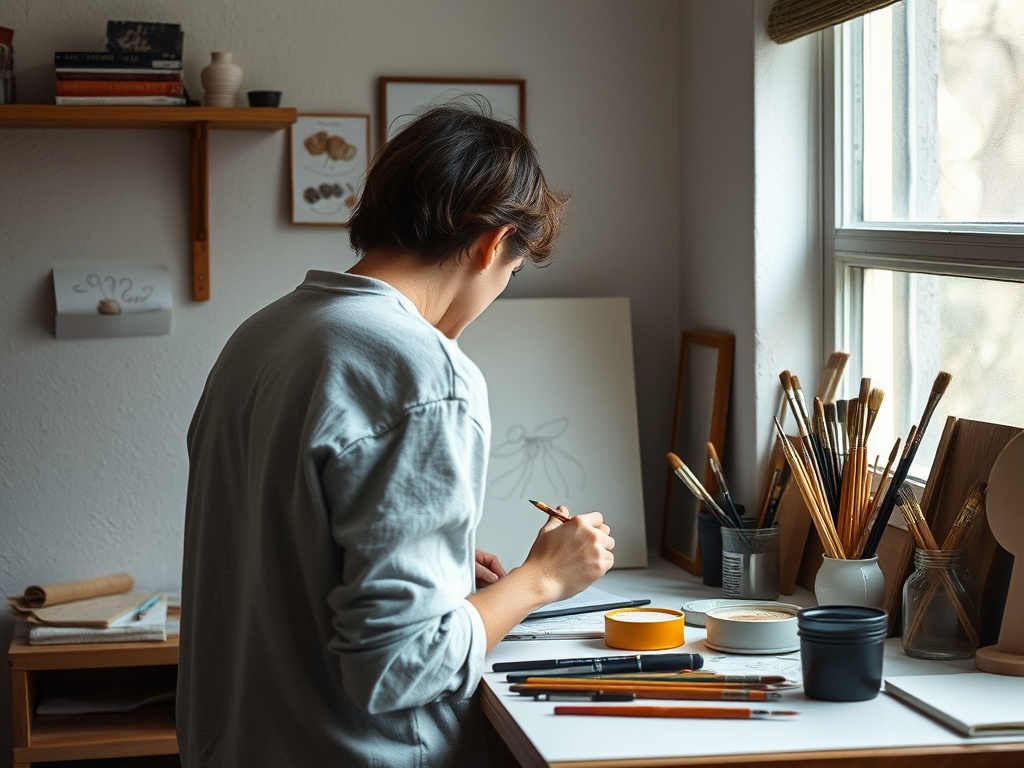
Avoid prompts that are so broad they become performance: 'make something beautiful,' 'express your soul,' or 'fill a perfect spread.' Better prompts direct your eye. Draw the same cup at three distances. Record five shadows in one room. Compare two reds. Trace the negative space around a chair. Draw only the reflections on a spoon. Write down every visible repair on an old object.
You can also borrow from close looking in museums. Spend two minutes describing without interpretation: lines, colors, scale, materials, light, posture, and placement. Then spend two minutes reflecting: What mood does this create? What might the maker be emphasizing? Then write questions. This observe-reflect-question sequence prevents premature conclusions.
The same habit supports other arts writing. If you eventually want to write a useful cultural essay that goes beyond summary, an art journal gives you a bank of concrete details. Strong interpretation begins with seeing accurately.
Let mess teach you
Beginners often abandon journals because pages do not match the imagined version in their head. That reaction is understandable, but it misses the point. Mess shows process. A crossed-out note may reveal a better word. A failed drawing may show that you did not understand the object's structure. A muddy color mix may teach more than a clean premade swatch.
Use labels without apology. Arrows, dates, short captions, and material notes turn a rough page into a record. Write 'too dark,' 'edge curves inward,' 'color changes near window,' or 'try again with softer pencil.' These notes make the journal interactive. You are not only collecting images. You are having a conversation with your attention.
Once a week, review without fixing. Put a small mark beside pages that taught you something. Do not rank them by beauty. Look for recurring subjects, avoided subjects, and sensory details you keep missing. Then choose next week's prompt based on that evidence.
Know when to seek outside help
DIY works well for building a private habit, exploring materials, and training observation. A class, mentor, or critique group helps when you want technical feedback, portfolio direction, or accountability. The moment to get help is not when your journal looks bad. It is when your questions become specific: How do I draw transparent glass? Why do my pages feel flat? How can I organize a series?
If your journal includes photographs of objects or collections, you may eventually want a more systematic record. That connects naturally to photographing collectibles for insurance, sale, and cataloging, where accuracy and repeatability matter more than expressive freedom. Your art journal can remain exploratory while other documentation serves practical needs.
Journal formats for different habits
| Format | Best for | Watch out for |
|---|---|---|
| Pocket notebook | Daily quick observations | Small pages can limit material experiments |
| Mixed-media sketchbook | Color, collage, paint, and texture studies | Thick pages can feel too precious |
| Loose cards | Low-pressure prompts and sorting themes | Easy to lose without a storage system |
| Digital tablet | Layered notes, photos, and portable palettes | Can become app management instead of looking |
Train the eye before the page
A noticing journal succeeds when it makes ordinary things harder to ignore. Keep entries small, specific, and honest. Over time, the pages will show not only what you drew, but how your attention became more patient, precise, and curious.
To measure progress, compare early and recent pages by looking for specificity. Are your color words sharper? Are your texture notes more exact? Do you ask better questions about shape, light, and context? Improvement in an art journal often appears first in language and attention, then in drawing confidence. That is why even written notes belong beside sketches.
Keep the practice sustainable by deciding what not to record. You do not need every page to include drawing, collage, reflection, and color. Some days a single observed edge is enough. A journal that survives ordinary weeks will teach more than an elaborate system abandoned after three impressive spreads.