
You can enjoy Shakespeare without understanding every word on first hearing. Focus on the situation, relationships, rhythm, staging, and repeated images; the language becomes clearer when you stop treating each line like a vocabulary test.
A practical way into the play
- Read a short plot summary before the performance so you can spend your attention on choices, not basic orientation.
- Listen for emotion and status before trying to decode every phrase.
- Track repeated words, props, images, and conflicts because they often carry meaning across scenes.
- Use reputable guides after the performance to deepen what you already noticed.
Give yourself the map before the poetry
Many people struggle with Shakespeare because they try to solve language, plot, and performance at the same time. Reduce the load. Before the show, read a brief synopsis, cast list, and setting note. You do not need a scene-by-scene explanation, and you should avoid interpretations that tell you what the production 'means' before you see it. A basic map lets you recognize who wants power, who loves whom, who is pretending, and who has been wronged.
The Royal Shakespeare Company's language resource is helpful because it treats Shakespeare's language as something alive in performance, not as a museum object. The Folger Shakespeare Library also frames difficulty as a problem that can be solved with attention and practice. That is a more generous starting point than assuming the play is beyond you.
If you are joining friends, agree on the level of preparation. Some people like reading the full play first. Others want the performance to be their first encounter. The same courtesy used for watch parties with no spoilers applies here: plot orientation is useful, but future-scene hints can flatten surprise.
Watch bodies before parsing clauses
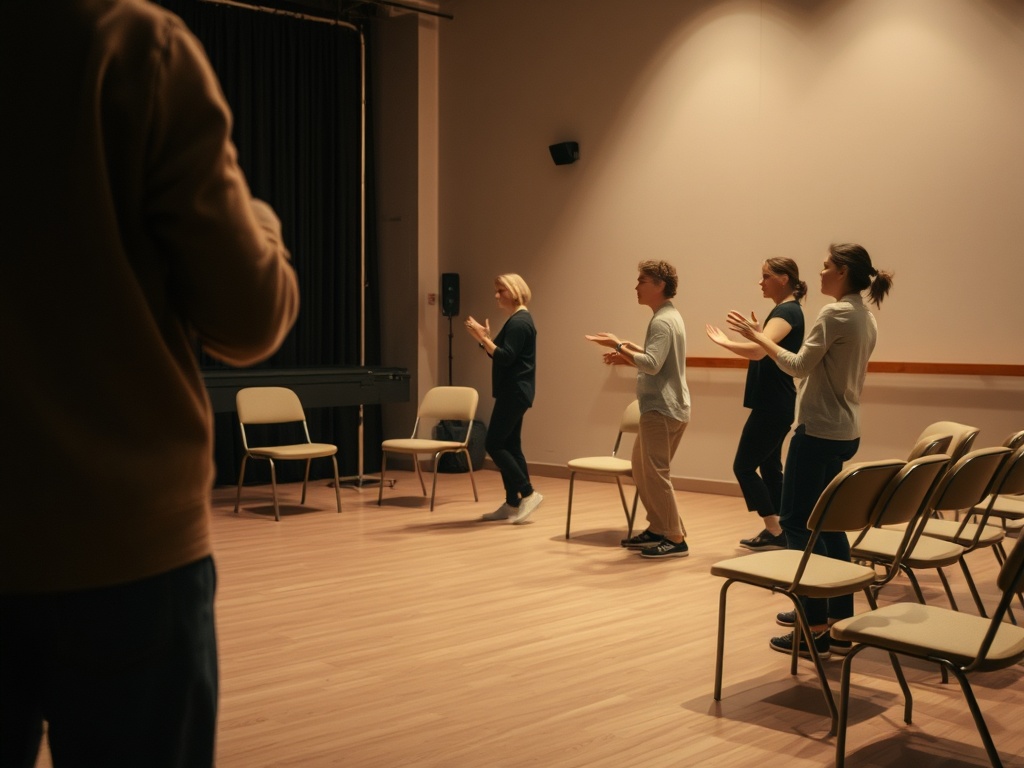
On stage, meaning does not live only in words. Actors tell you who has power by distance, eye contact, stillness, interruption, gesture, and how they handle silence. If a speech feels dense, ask what the actor is doing to the other person. Pleading, seducing, mocking, bargaining, confessing, threatening, and grieving are easier to follow than every syntactic turn.
Status is especially useful. Who stands while another sits? Who touches whom? Who gets interrupted? Who is alone when they speak truthfully? Once you understand the pressure in the room, unfamiliar phrasing becomes less intimidating. You may not catch every metaphor, but you can still understand the conflict.
Listen also for rhythm. A fast exchange may signal wit, panic, or combat. A sudden pause may matter more than a difficult word. Verse and prose shifts can mark changes in mood, class, intimacy, or control, though productions vary in how strongly they highlight them. Treat these patterns as clues rather than rules you must master in advance.
Use repeated images as anchors
Shakespeare often builds meaning through repetition. A play may return to images of disease, weather, clothing, blood, debt, sleep, or sight. You do not need to interpret each image perfectly. Just notice recurrence. If several characters talk about seeing and blindness, the production may be asking who understands the truth. If clothing keeps appearing, identity or disguise may be central.
Keep a small mental list during the show: names, objects, repeated words, and emotional reversals. Do not take heavy notes in a dark theater unless it helps and does not disturb others. Afterward, write three things you noticed. Then consult a trusted edition or guide. The Folger guide to Shakespeare's language can help you connect what you heard to patterns in the text without replacing your own response.
This approach also protects against a common beginner mistake: assuming confusion means failure. Live performance always includes partial attention. Even experienced viewers miss lines. They recover by tracking action, not by freezing over one phrase.
Know when modern context helps
Some productions keep an early modern setting. Others move the play to a corporate boardroom, a prison, a war zone, a nightclub, or an abstract stage. The setting can clarify power structures, but it can also introduce new symbols. Ask what the setting makes easier to understand. Does it clarify class, gender, violence, surveillance, family duty, or political ambition? Then ask what it complicates.
Do not assume the director's concept is the only meaning. A production is an interpretation of the play, not the play itself. That distinction matters. If one staging makes a character sympathetic and another makes the same character frightening, both may be drawing on real possibilities in the text. Your job as an audience member is to observe choices and test them against what happens on stage.
If the language starts to feel dense again, return to the simplest questions: Who wants what? What changed in the scene? Who knows something the others do not? What image or sound keeps coming back? These questions carry you through difficult passages.
After the curtain call, make the play yours
Post-show conversation is where Shakespeare often opens up. Ask friends what they understood before asking what they missed. Compare moments, not just plot points. One person may remember a gesture, another a lighting shift, another a line. Together those details create a fuller picture.
Reading a review after the show can help, especially if it discusses staging choices without pretending there is only one correct interpretation. If you want to build that habit, use the same cautious method you would use to read a movie review without letting it ruin the experience: let criticism sharpen your attention, not overwrite it.
What to focus on during dense passages
| Anchor | Question to ask | Why it helps |
|---|---|---|
| Relationship | Who has power right now? | Status is easier to see than archaic phrasing |
| Action | What is the speaker trying to do? | Speech becomes behavior, not decoration |
| Repetition | Which images or words keep returning? | Patterns reveal themes gradually |
| Staging | What changed in movement, light, or sound? | Performance choices translate difficult text |
Let partial understanding become momentum
The goal is not to translate every line in real time. The goal is to stay present enough that language, action, and performance begin helping one another. With a plot map, a few attention anchors, and a willingness to miss some words, Shakespeare becomes less like a test and more like live drama again.
A final helpful habit is to read one scene after the performance rather than before it. Choose the scene that felt most alive or most confusing, then compare the printed language with your memory of staging. This keeps the text connected to performance instead of turning it into homework, and it lets the production remain the primary experience.