Car battery testing checks more than whether the lights turn on. A useful battery test looks at resting voltage, the battery's ability to hold voltage under load, and reserve capacity or related ratings that show how much electrical support remains when demand rises.
Battery-test snapshot: Voltage can show state of charge, but it does not prove the battery can start the vehicle. A load or conductance test checks strength under demand, while reserve capacity helps explain how long the battery can support electrical needs if charging is weak or accessories are left on.
Why a battery can test "charged" and still fail
A 12-volt battery is a chemical storage device. It can show acceptable voltage after charging but still have weak plates, a bad cell, poor connections, or limited cranking ability. That is why technicians rarely rely on a simple voltage reading alone when a driver reports slow cranking, repeated jump-starts, warning lights, or electrical glitches.
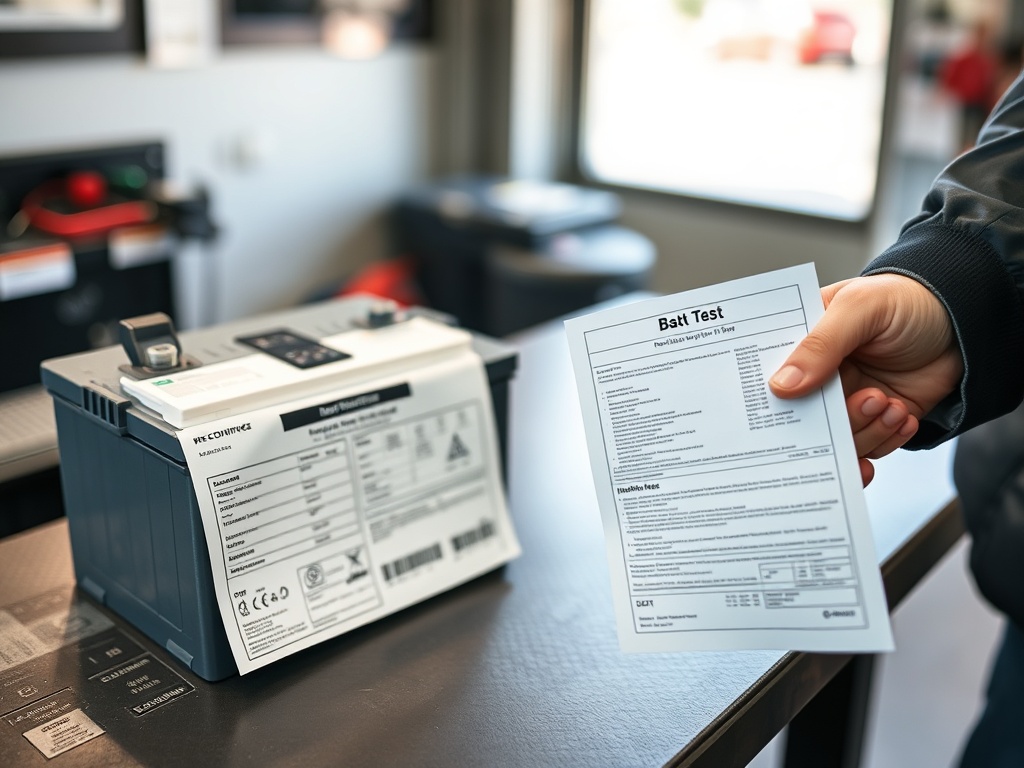
AAA's battery test result guide separates readings such as good battery, good-recharge, charge and retest, replace battery, and bad cell. Those categories matter because a low state of charge is not the same as a failed battery. A weak but rechargeable battery may need a charger and a retest. A battery with an internal fault usually needs replacement.
The three terms drivers hear most often
| Test term | What it helps reveal | Common misunderstanding |
|---|---|---|
| Voltage | State of charge at the moment of measurement | A good voltage reading does not prove cranking strength |
| Load testing or conductance testing | How the battery behaves when demand is applied | A quick parts-counter test may still need context from the vehicle |
| Reserve capacity | How long the battery can provide power under a defined load | It is not the same as cold cranking amps |
Consumer Reports explains reserve capacity as a measure of how long a battery can run a vehicle's electrical load if the charging system fails, and cold-weather performance as a separate starting-power concern. For owners, the key is not to memorize every rating. It is to ask what the test result means for the vehicle's actual symptoms.
Voltage: useful, but limited
A resting voltage check is often the first step. It can show whether the battery is clearly discharged, recently charged, or suspiciously low. But voltage changes with temperature, recent driving, surface charge, and accessory use. A vehicle that has just been jump-started may show a decent number briefly without proving the battery can recover.
This is why a technician may charge the battery before testing. If the tester says "charge and retest," that is not stalling. It means the battery is not in a reliable condition for a final judgment. Replacing a battery before confirming the state of charge can waste money, while ignoring a weak result can leave the driver stranded.
Load: the closest look at starting strength
Starting an engine demands high current for a short period. A load test or electronic conductance test estimates whether the battery can deliver that current without voltage collapsing. The test is especially useful when symptoms include slow cranking, clicking, dimming lights during start, or repeated no-starts after short trips.
Cold weather makes this harder because engines are more difficult to turn and battery chemistry slows. Heat also shortens battery life over time. AAA's battery selection guidance explains ratings such as cold cranking amps and reserve capacity, but the replacement battery still needs to match the vehicle's size, terminal layout, and required specifications.
Drivers of EVs and hybrids should not overlook the 12-volt battery. Even though the vehicle has a high-voltage traction battery, the low-voltage system often powers control modules, lighting, locks, and startup logic. That connection is one reason brake service on EVs can involve more than pad thickness.
Reserve capacity: the overlooked rating
Reserve capacity is easiest to understand during a charging-system problem. If the alternator or DC-DC converter is not maintaining the 12-volt system, the battery becomes a temporary electrical supply. A battery with poor reserve may leave little time before lights, ignition, steering assist, or control modules struggle.
That does not mean a driver should intentionally continue after a charging warning. It means the rating helps explain why two batteries that both start the car today may behave differently during accessory use, winter starts, or charging faults. Reserve capacity is one piece of the right-battery decision, not a ranking by itself.
What a good diagnostic process rules out
A battery complaint may not be a battery failure. A technician should check terminal condition, cable tightness, charging output, parasitic draw, belt condition where applicable, and stored diagnostic codes when symptoms point that way. Corroded terminals can mimic a weak battery. A failing alternator can kill a new battery. A module that does not sleep can drain an otherwise healthy battery overnight.
The FTC auto repair basics advise consumers to ask for written estimates and understand diagnostic charges. That is useful here because charging-system diagnosis may take time, and the cheapest battery swap is not always the correct repair.
When replacement is the smarter choice
Replacement becomes more sensible when the battery fails a proper test, has a bad cell, cannot hold charge after recharging, is the wrong type for the vehicle, or is old enough that repeated symptoms are likely to continue. Vehicles with stop-start systems, heavy accessory loads, or absorbed glass mat battery requirements should not be downgraded without manufacturer guidance.
If the no-start happened after a pothole, collision, or underhood repair, connect the clues instead of treating the battery in isolation. Impact-related symptoms may point to cables, grounds, sensors, or alignment and tire damage. For suspension-related clues, see signs you need an alignment after hitting a pothole.
Turn Test Results Into a Smart Service Decision
Ask for the actual test result, not just "good" or "bad." Was the battery fully charged before testing? Did the test compare measured capacity with the rated capacity? Did the charging system pass? Were the terminals clean and tight? These answers turn a battery purchase into a confident repair decision.
If the same vehicle also has cooling, A/C, or belt symptoms, do not let a dead battery distract from the root cause. Electrical testing and mechanical diagnosis often meet under the hood, including in issues such as A/C compressor failure.